Monday, 25 May 2015

ProDUCing

I reeeeeeally wish I could record some of the conversations I have here in Gulu... Or even just some of the conversations I overhear. Today we had a pretty slow day in theatre because the medical students are doing exams this week. So I just sat around chatting for a bit with some of the nurses and anaesthetists in between cases. We were discussing the wedding of one of the surgeons (third marriage) to a much younger woman. Apparently she's a very clever woman because he has the money in the bank ('IN THE BANK' was the phrase of the day really), will treat her well and she won't have to work anymore as a midwife, which is a major bonus.

Hard at work...
 When I was asked about my marital status I said I'd been divorced three times (and that's why I actually came to Uganda) the sarcasm was lost on one poor intern who wondered how my father had so many cows.

It is a completely different world here. Family is the epicentre of everything. I honestly have never heard so much discussion about children, pregnancy, menstruation and uteruses in my life. Tuesdays and Thursdays are gynaecology surgery days, and the day passes so quickly with lists full of women eager to discuss their gynaecological and obstetric problems and concerns, and everyone from the surgeon to the cleaner to the medical student contributes to the conversation. All sorts of tips and tricks to 'produce' from various plants and herbs to special rosaries. I found the use of the word 'produce' particularly strange in the beginning but now I've started using it myself (pronounced in the right way as well: proDUCE),  but then I got carried away and nobody understood my joke of calling the newborn babies proDUCTs  so I gave up on it.

I seem to have had loads of conversations with the women here about babies and pregnancy, and they know I'm starting a six year training programme in July, so one friend pulled me aside the other day to tell me that she'd worked it out and if I start proDUCing as soon as possible after I finish I could have at least four children easily before I hit the menopause. Phew. A few weeks ago I told one of the young surgeons I had to leave early because I had a headache - his first question was when was my last menstrual period and before I even answered he said it was probably just PMS. Everyone else in the operating theatre agreed and advised me to 'take some tea'.

A woman's ability to produce children is of major importance here. In a society where polygamy is accepted and very common, if a woman doesn't have children she doesn't command the same attention or power as other women or wives. Most women I've met would like to have four or more children, and this is naturally supported by the strong religious presence in society. One of the obstetricians asked me what I knew about causes of infertility and I said 25% of the time it is a female problem, 25% male and 50% a combination of the two. He laughed, and said I was right, here but in Uganda it is the woman's fault 100% of the time. It really is a man's world.

I could only tell him about the one time I knew for definite it was the doctor's fault a woman couldn't conceive. A few weeks ago we were doing a diagnostic laparoscopy (keyhole surgery) investigating infertility, where a 35 year old woman stopped menstruating two years ago after her last pregnancy. The patient arrived down for surgery and we gave her the general anaesthetic as usual and we had some trouble with her blood pressure at first, but once she was settled the surgeon began to set up and I started having a mosey through her medical notes (which were basically like a few post-its stapled together). On the very first page it documents her medical history - noting that she had 3 children and her last pregnancy 2 years ago ended with an intrauterine foetal death (stillbirth), which was complicated afterward by bleeding so she had a hysterectomy. I told the obstetrician he could put away his fancy keyhole cameras because I had the diagnosis.  He examined her and confirmed it. Obviously having no womb anymore was the cause for the infertility and lack of periods, and this part of the history had just been overlooked at the clinic visits.

Even worse than the unnecessary tests and the unnecessary anaesthetic and the expense of investigations and clinic visits, this woman had had her womb removed in another district hospital and nobody had even told her. So when she woke up from the anaesthetic that day, expecting an answer and a solution to her problems conceiving, she was met instead with the devastating news she'd never conceive again. It must have been absolutely heartbreaking, especially in a society which places so much importance on reproduction, where women are revered for their capacity to deliver and rear babies, and the womb itself in many ways symbolises the very essence of their womanhood and proud motherhood.

In addition to their role of prolific baby producing, the women I have met in Uganda are also incredible natural midwives. One of my very first experiences, almost three months ago now, was a woman arriving for an emergency Caesarean section, collapsing on the tiled floor of the operating theatre and pushing the baby out on the floor. I just stood back gaping uselessly as the anaesthetist delivered the baby while still maintaining a chat with the nurses. When I suggested moving her to a trolley I was told she needed to rest, and twenty minutes later I almost tripped over her, still lying on the tiled floor, having a wee snooze! A friend in Gulu Regional hospital told me she was left alone at one stage on the labour ward, a woman started delivering a baby and the cleaner swooped in, cast aside her mop, took the only pair of gloves on the ward and expertly delivered the baby without breaking a sweat. She presumably nonchalantly went back to the mopping after that, no big deal eh?


Sudoku

Wednesday, 15 April 2015

The Lion King

Beautiful sunset at Kidepo National Park (trees <3)


I have just realised all my blog posts are about working, and I’m giving somewhat of a false impression about my time here. I do in fact spend my weekends hunting lions.

My first experience of wildlife here was on a day trip to a hotel called Chobe in Murchison falls, two hours west of Gulu last month. After a long hard week at work I went with a few friends from Lacor/Gulu to enjoy the infinity pool overlooking the Nile and hoped to spot a few elephants. We got a whole lot more than we bargained for.


Giraffes at Murchison
Firstly, not two minutes after we drove into the park, we came across a big group of giraffes of all shapes and sizes (all very tall obviously). Naturally our driver completely disregarded the rules about staying on the track, and drove our minivan into the clearing. They stood around and watched us pretty uninterestedly, munched on trees, as if we were just another part of the wildlife collection in Murchison. A big four wheeled, ten headed primate perhaps.


Nelly
After taking a few hasty photos we moved onwards through the park. About five minutes later we actually had a major disaster resulting in the untimely death of a small suicidal baboon who jumped in front of our van (moving at 10km/hour).  This is not something I am proud of, but in the interest of full disclosure (and hoping nobody from the Ugandan wildlife authority reads this – unlikely) we had to hide the evidence because of the $500 fine that is imposed on anyone who kills an animal in the park. John* (not his real name) got out of the van, confirmed the diagnosis of death and threw the baboon into the bushes. Unfortunately he had a shite aim so our driver had to relocate the body to somewhere where it was not actually visible. RIP Baboon. Unfortunately this happens frequently enough in the parks as they cross the roads.

Although somewhat shook, we didn’t let that incident completely dampen our spirits. We got to Chobe and were not disappointed by the pool and the views. We had a stroll around the shores of the Nile, full of hippopotamuses hiding from us, a huge crocodile and found an elephant watering hole. Surrounded by hippos, this elephant was just catching a few rays and drinking some water, minding his own business. Apparently later that day loads more elephants joined him and they had a group bath!

We spent the day relaxing at Chobe by the pool before returning back to Gulu. Having whet my safari appetite, I decided to join almost the same group going to Kidepo national park the following weekend. We had all sorts of fantasies about camping out in the wild and toasting marshmallows by the fire. But it soon dawned on us that it is rainy season here - torrential rain, at least once a day (I'll have to write an entire post on the rain - it is insane). 

Our trusty jeep at Kidepo!
Anyway we set sail for Kidepo at 6AM on a Saturday morning. Sarah* (her real name) had asked a driver from work called David to bring us there and back. We set off in high spirits, determined not to kill any animals (and to allay any reader anxiety, we succeeded - no more animals were harmed in the making of this post). The journey only took five hours, much shorter than we had anticipated, given the road conditions in this part of the country. We reached the park early in the day, had a picnic lunch outside and made our way to our lodgings - small little bandas (thatched huts) located within the grounds of the park. At this point I feel it is necessary to point out that by the time we reached the bandas, we had all developed a Stage 5 peanut butter addiction. And I may as well get it off my chest that between five of us we managed to polish off an entire 600g jar of PB within the 24 hours we were allowed to be in the national park. Alarming. 

Oh, just another tree I fancied
So on Saturday evening we took our own car around the park to do a bit of preliminary animal spotting, having reserved a formal game drive for the following morning. Unfortunately it is rainy season here in Uganda, which means that the animals don't congregate easily at sparse watering holes as there is water everywhere. This makes the landscape more lush, but makes it more difficult to find the fauna. I did get quite a bit of slagging for my fondness for the flora. Seriously though, the trees are incredible against the backdrop of hundreds of miles of safari plains! Oh there I go again. 


Angry buffalo on his toblerone

We kept our eyes peeled while driving around, listening to Whitney Houston on the stereo (not joking, turns out David is a big fan of the power ballads). Apparently buffalo are rare. Not in Kidepo they're not. We must have seen THOUSANDS. At one point on the game drive on Sunday morning we came across a group of few hundred at least. Our guide explained that buffalos are apparently half blind and half deaf. So when our car was near them they could sort of hear and see us, but after a few seconds they started backing away en masse after smelling us. This did nothing for our self esteem but it was bizarre to see a huge herd of animals take around 15 seconds to register our presence. #playingitcool
Angry buffalos in large intimidating group

Apparently buffalos can travel in herds of over a thousand, though when they get older they are sometimes shunned from the herd and have to go it alone. Solo buffalo are supposed to be super aggressive. Someone on our trip suggested the old rejected buffalos should hang out together, rather like a retirement home. Seems reasonable, I can't believe they haven't come up with it yet.
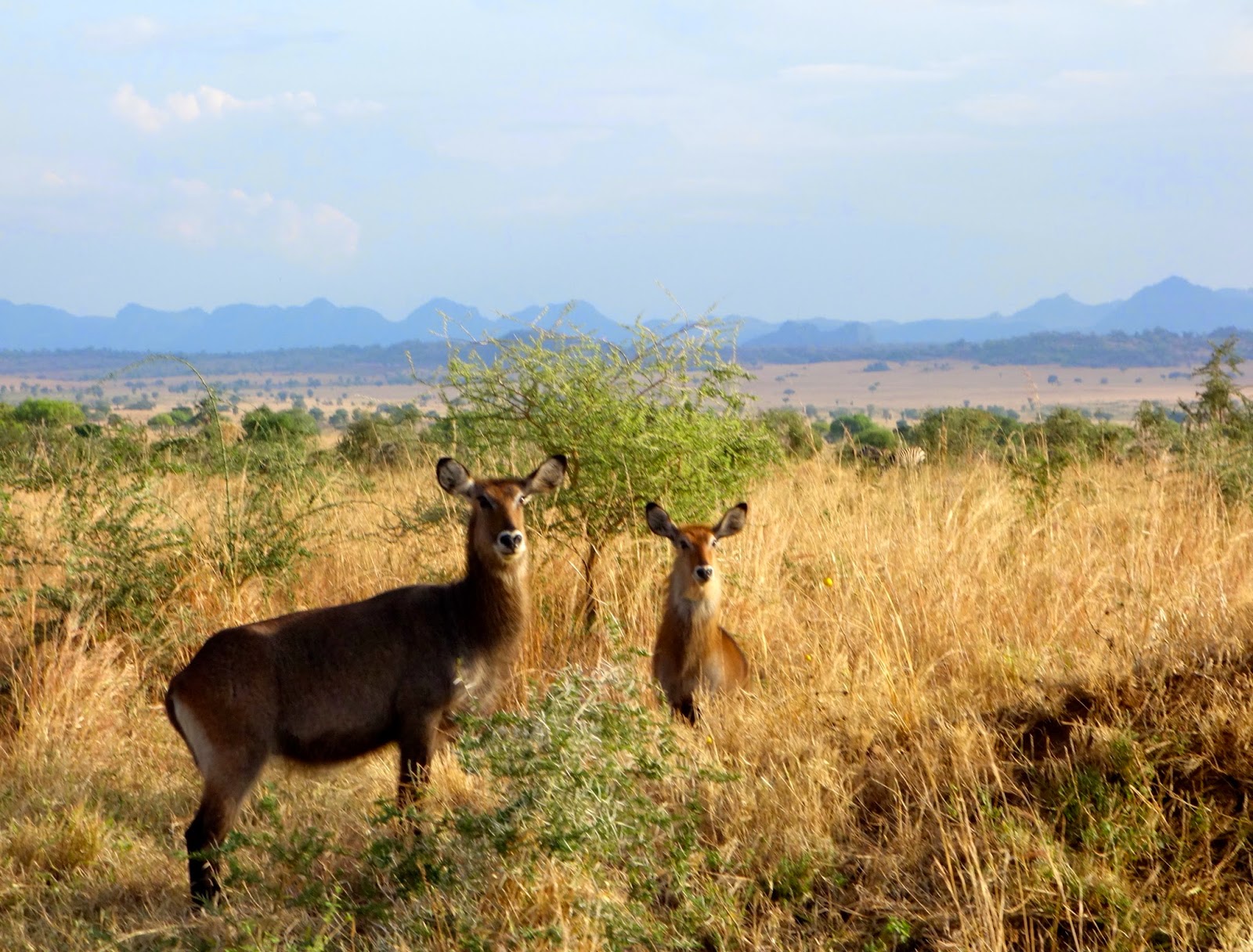
Waterbucks Kidepo


As we drove through the park we spotted lots of warthogs, waterbucks and zebra. We went back to the bandas for some beauty sleep for our game drive on Sunday morning.


Cheetaaaaaaah
On Sunday morning we arose before dawn, pitch black outside. It was freezin. And drizzling. We were not in top form when it started pouring rain as we were about to start our drive in an open safari jeep. Undeterred (and determined to find lions) we insisted on proceeding against the advice of our guide. I would say the first hour we saw very little - the fog and rain were so dense we could have been passing herds of elephants and wouldn't have known. We were soaked to the skin. We were absolutely convinced we were driving by all the animals in the park and we would never find a lion. And then the rain stopped and we could see. More importantly, we saw... A CHEETAH! The guide said there are maybe only five in the entire park, he has seen one a handful of times and the little cutie decided to cross in front of our jeep and posed for pictures. We literally felt like we had won the lottery. We all sat in the car, completely transfixed and willed it not to move as we took a few pictures to remember the moment. I genuinely am not a cat person but that cat was gorgeous.


The Zebras as the fog lifted at Kidepo
We were in such high spirits after that it gave us new gusto to search for more. Around 8.30AM the really dense fog suddenly lifted and we started to see a horizon. I cannot even begin to describe the vastness of these African plains. Well actually according to Wikipedia, Kidepo spans over 1442 square kilometers and this only includes the part of the park that is in Uganda (much more is in South Sudan). With so much land to cover it makes seeing so many animals an incredible feat for a mornings driving! I think of all the animals we saw on Sunday morning, the zebras were probably my favourite - not because they're the most rare or the most dangerous but because they are so stylish. And I think they know it.


Foggy dew


Lioness
 Having seen the cheetah we all agreed we could go home happy. We had come in search of lions, but frankly by 9.30 we had given up hope as we knew they hunted at dawn. We actually couldn't believe our luck (nor Amy's eyesight) when she spotted a lioness in the bushes. She was so well concealed we actually had driven past and had to reverse. Again, we were all a bit stunned for a minute before taking dozens of pictures, hoping she would move or roar and then IMMEDIATELY regretting those hopes as she stood up 10m from our truck and started asserting herself. Or perhaps yawning. It was pretty intimidating.

We actually almost drove on, but then our guide luckily pointed out that there was a second lion in the bush beside her - again hidden away and so well concealed it is no wonder we hadn't seen him sooner.

Lion


Naturally emboldened by god-knows-what and feeling very brave at this point, we drove off road to get a better view. Sure enough there was a 'teenage' lion lounging in the shade of the bush, completely unperturbed by our arrival. Not in the slightest bit interested in eating us which was a major plus. 

Between the two of them they were an amazing sight. We think mother and son. I actually cannot believe we got so close. I think Sarah and Stuy pretty much died of happiness.  I mean short of seeing Mufasa holding up Simba to the sun we lived the Lion King experience. We drove out of the park that day one happy happy bunch. 

So having seen elephant, lion and buffalo, it only leaves the leopard and rhino of the African Big 5. So much to see SO LITTLE TIME!


Zebras up to their old tricks


Pharrell is Happy

I actually cannot believe I have been here six weeks already – the time is literally flying by!

I have spent the last few weeks in theatre doing anaesthesia. What an experience! Although the principles are the same, it is really different to home. There are relatively few drugs, limited equipment, minimal monitoring and there seems to be a lot of emergency / near-fatal incidents that we narrowly and sketchily navigate. No complete disasters yet thankfully (*touch wood*). I’ll say one thing for this place though; it certainly brings out ones creativity and resourcefulness. Today for example I fashioned a sharps-box out of an IV fluid bottle, and the other day I made a suction catheter using an IV line set and a surgical blade. Sure who knows what’s next? I’m thinking about creating a heart-lung bypass machine from empty Nile Special and wine bottles before I leave: watch this space. 

Highly organised anaesthesia workbench: pre/intraoperative
I have a great laugh in theatre with the staff. To say this place is chilled out is a major understatement. Some days we end up starting the first case at 10.30AM. (Scheduled for 8.30). The nurses are regularly either missing in action or are having a snooze on a trolley in theatre. We are forever running out of sterile linen (sheets, gowns etc), to the point where some days we finish early – not for lack of doctors or nurses or patients: purely no clean sheets. It’s the simple things really!

I am no longer much of a novelty in theatre and everyone is pretty much used to my big white mzungu face by now. Of course my name is still a bit of a challenge – but we’ve resolved that now as most people have taken to calling me Farrell, pronounced Pharrell. This is not a joke. Neither is the sporadic serenading of ‘my song’ Happy, often preceded by ‘Pharrell why are you not smiling today?? You should be more like your song! Because I’m HAPPYYYYYYYYYY...’. For anyone who doesn't understand this reference, please click here: https://www.youtube.com/watch?v=y6Sxv-sUYtMI 

I mean I hate to be a Debbie-Downer, but recent situations where it might have been inappropriate to be humming my theme song:
  1.       When that woman’s spinal anaesthetic wore off in the middle of her hysterectomy surgery. [Painful for everyone]
  2.       When the laryngoscope batteries ran out during a difficult intubation.
  3.       When the ‘emergency C-Section’ patient unexpectedly pushed the baby out on the floor of the operating theatre (this happened twice).
  4.       Blood pressure of 54/32mmHg.


I will admit on these occasions I have struggled to remain calm, mainly because of the slow reactions of others and their seemingly nonchalant attitudes facing really urgent situations. I am definitely underestimating my colleagues though, because despite the turtle-style pace, situations are remedied, rectified and resolved with or without my hysterics every day. The answer to every stressful situation here is laughter – whether this is a defense mechanism, a relief release after-the-fact or genuine sadism, it seems to keep everyone in good spirits and relationships on good terms behind those operating doors! 

Even the patients laugh. One day we had a full and frank discussion with a woman who was having her womb removed (under spinal anaesthetic so she was awake for the procedure), about her daughter’s eligibility. The intern, Felix, had spotted her in the family waiting area (ie. the corridor outside theatre) and she had piqued his interest. We discussed her cooking skills at length, as well as the dowry and her likelihood of fertility. By the time we had her womb out he had a date with the daughter, never a missed opportunity!

Old EMO ventilator with manual bellows: uses ether

Glostavent Ventilator: uses halothane and runs on an oxygen concentrator.


I am really enjoying myself here. I'm getting great exposure to medicine and surgery in a developing country which is really something you cannot learn in a book. I've also encountered some incredible doctors who are really well capable, and I have been really impressed by the medical students' knowledge and skillset which is very promising for the future. I think this has been a really important realisation for me: to appreciate that the majority of doctors I've met in Africa are fully capable of treating patients to an acceptable standard without any help from a mzungu. It is not the lack of homegrown skill or knowledge that limits care here, but rather the lack of resources. Granted, Lacor is considered one of the best hospitals in Uganda. What sets it apart from other hospitals in the region is the funding from Italian and Canadian (and now a small part Irish!) organisations, charities and individuals. This not only keeps the hospital afloat, but invests in technologies and equipment to progress the standard of care, striving toward European and US standards. For example, each of the ventilators cost £20,000, funded by African Mission a few years ago. These machines are what we consider life-support machines at home: breathing for the patient when they cannot manage themselves. No other hospital in the region can afford even one of these. I spoke to doctors working in Gulu Referral Hospital five miles down the road who have several patients who would benefit from this simple machine and may well die without it. It doesn't matter how many doctors see those patients - be they Irish, Canadian, Chinese or Ugandan - it won't change the simple fact that it is the equipment and drugs that matter most of all. I haven't made any specific requests regarding how our donation to Lacor should be spent - I have heard many stories about donors insisting on spending money on specific areas that do not benefit the greatest number of patients (like expensive equipment that may fall into disrepair). Instead it will go toward the general running costs of the hospital: funding essential drugs, powering the generator when the electricity goes out, laundry, hospital maintenance etc. The simple stuff we really can't survive without! 

And as for me being here, I am definitely gaining at least as much from the experience as I am giving back to the community. I am benefiting so much I sometimes feel guilty. So all I can say at the moment with certainty is that I'm providing an extra pair of hands, sometimes another perspective or idea on a clinical problem and an enthusiasm for work (which sometimes wanes in the evening after inhaling a lot of halothane, but an enthusiasm nonetheless!). I consider this stint volunteering as reconnaissance for future work volunteering - finding out what works, what is useful for hospitals with limited resources and what is really needed in developing countries so when I have more skilled training I can really put it to good use. Even though I've had some tough days (I will admit to at least one occasion of homesickness, a serious craving for a Shell's goats cheese sandwich and cup of Barry's tea), this is the single best decision I've ever made - and the best thing is I have many many more weeks to go! 

Sunday, 22 March 2015

Finding Nemo and the Real Pain in the Neck

          Finding Nemo. A masterpiece if I may say so myself.      
I’ve realised this week that I need to start sleeping in the ICU to see the real action because all the crazy, exciting and scary things happen at night! On Friday morning I came in and met the patient we have now affectionately dubbed ‘The Fisherman’. He is a 25 year old who was out fishing on Thursday evening with friends and caught a wee fish. He put the live fish in his mouth between his teeth (God only knows why) but somehow took a big breath in and managed to inhale the fish into his lung. He started choking and his friends brought him to a village hospital, where they quickly identified he wasn’t able to breathe. That hospital didn’t have any pulse oximeters to measure the oxygen levels but he was going a bit blue, so they put a big needle in the neck to create a passage for air. Unfortunately that didn’t help much, and as said in my last post the vast majority of hospitals here don’t even have access to oxygen, so they sent him to Lacor hospital for further management. When he arrived he had oxygen saturations of 72%, and he was obviously pretty sick (as anyone with a live fish flapping around in his lung would be!). Ray and Francis took him straight to theatre, where it took two hours for the oromaxillofacial surgeon to remove the little fish piece by piece using a bronchoscope (lung camera) and a forceps. It was stuck headfirst between the right main bronchus and carina (see very detailed diagram attached). The next day when I saw him, he was talking to his friends, looking a bit worse-for-wear but thankfully (and rather miraculously) alive.

Francis (white coat) and the patient doing well two days post-op.
On Tuesday night a lady who had just had thyroid surgery earlier that day complained of pain in her neck, and the nurse Albert quickly realised she was bleeding. Bleeding like this can cause big problems in the neck as it can compress the airway and the vessels supplying the brain with blood. Her oxygen saturations dropped to only 70% and she quickly started slipping into unconsciousness. The fast acting nurse contacted the anaesthetist Francis and anaesthesiologist Ray who woke up the surgeon in the middle of the night to take the patient back to surgery straight away. There was a huge amount of swelling around the trachea (airway) but Francis managed to intubate, and after an hour of surgery stabilized the patient enough to put in a tracheostomy (semi-permanent airway in the neck which we will remove in a few days). I tottered in the next morning blissfully unaware of all this commotion overnight. I found her sitting up, breathing a bit of extra oxygen through the tracheostomy, but alive. Bleeding thyroids, although rare, are one of those situations that make anaesthetists and surgeons alike involuntarily shudder because they can go so horribly wrong and have a high mortality if rapid action is not taken. There is no doubt that Francis, Ray and the nurse Albert saved that lady’s life.

As you can probably deduce, I am massively impressed by the skills and knowledge of the people around me here, particularly Ray and Francis who have really welcomed me and have taught me so much. These are just two examples this week of lives saved at Lacor hospital where otherwise and elsewhere would have meant certain death for the patients. I feel like I am gaining so much more than I could possibly hope to give back to this place, between learning new skills, knowledge and experience and I am so happy to be here. Although I can take no credit for helping in these cases, it definitely makes the tough and sad cases easier knowing that Lacor Hospital and its skilled staff tipped the balance in favour of these two patients at least, and kept the greedy Grim Reaper at bay.


*More Good News*

Ray with a 24 year old who was in a road-traffic accident (* very common here - do not get me started on Ugandan drivers) : several broken ribs on the left and a collapsed right lung, successfully resuscitated and treated - discharged to the general surgical ward. 


45 year old man with air under the diaphragm from a perforated duodenal ulcer. This was repaired in surgery and he was discharged a few days later to the ward.

14 year old girl who fell from a mango tree three days before coming to hospital with shortness of breath and pain. XRay shows left haemothorax (blood in the lung space). She had a chest drain put in and was discharged to the surgical ward a few days later.